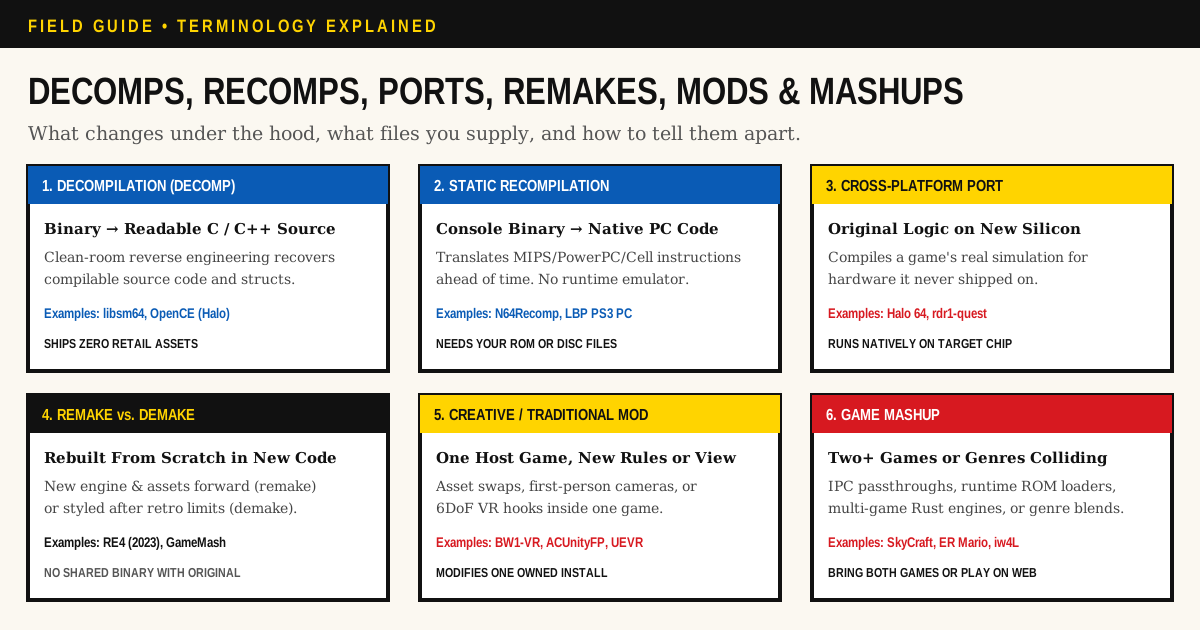
You no longer need five years of x86 assembly experience to prototype a game mashup. Coding agents, portable decompiled physics libraries, and shared-memory templates have compressed weeks of boilerplate into a weekend project.
Picking the wrong starting tool can still cost you your AI subscription or your Steam account. Before pointing an autonomous agent at an installed game folder, choose the right technical track for your build. You also need to understand why viral reverse-engineering wrappers like REA (Reverse Engineer Anything) carry serious account, anti-cheat, and legal risks.
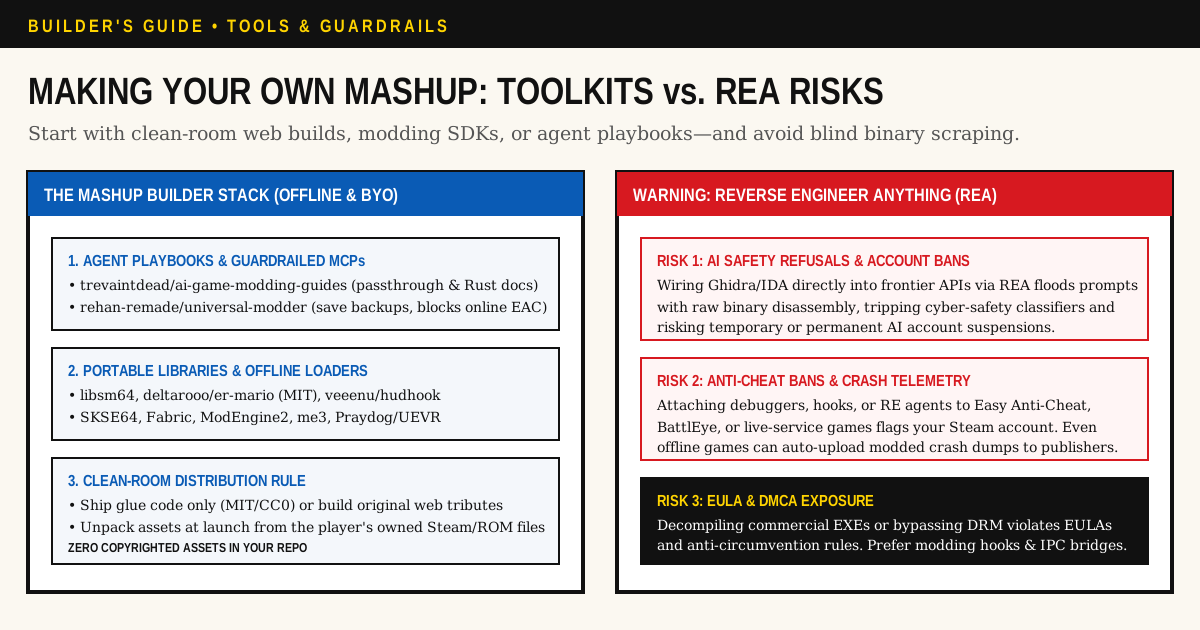
Ship glue code, never publisher assets, and never attach reverse-engineering tools to a game with active anti-cheat.
| Mashup track | Best starting template | Languages & hooks | IP & ban risk | Example to study |
|---|---|---|---|---|
| 1. Clean-room browser hybrid | Three.js, Phaser, or Godot Web export | TypeScript / JavaScript / GDScript | Low (original code & art) | Slay the Spore, GameMash |
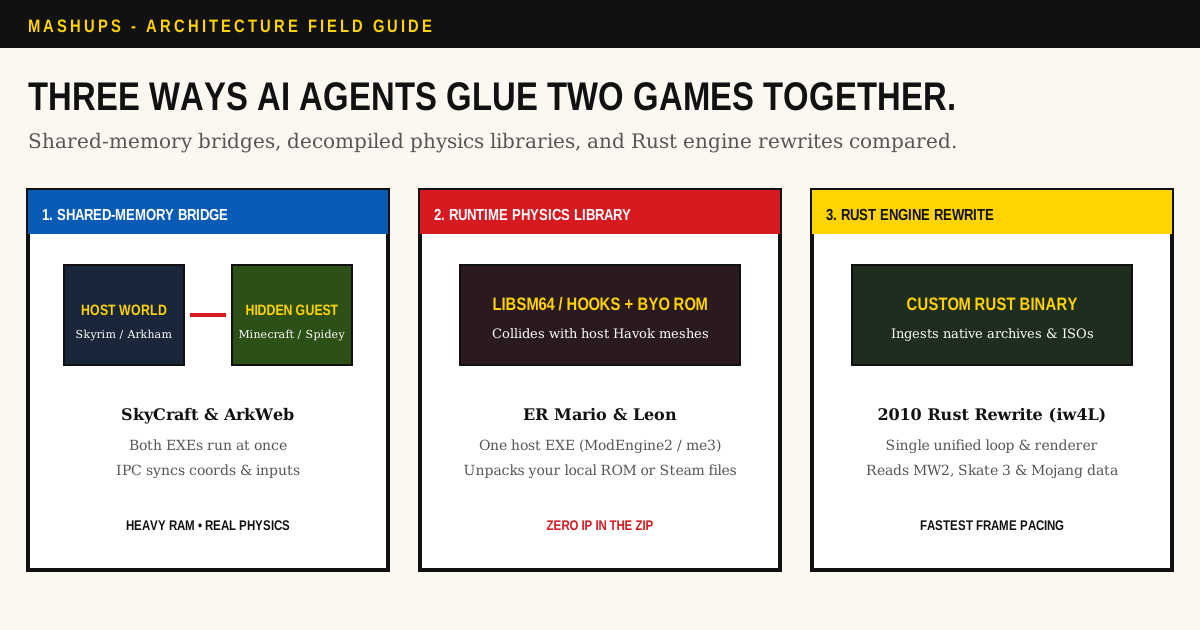
| 2. Runtime BYO asset / physics bridge | deltarooo/er-mario (MIT) | Rust / C, libsm64, hudhook, me3, ModEngine2 | High IP sensitivity; keep 100% offline | ER Mario, Leon in the Lands Between |
| 3. Shared-memory passthrough | chasmlol/SkyCraft + ai-game-modding-guides | C++ (SKSE64), Java (Fabric), Windows IPC | Medium-High; offline only | SkyCraft, ArkWeb |
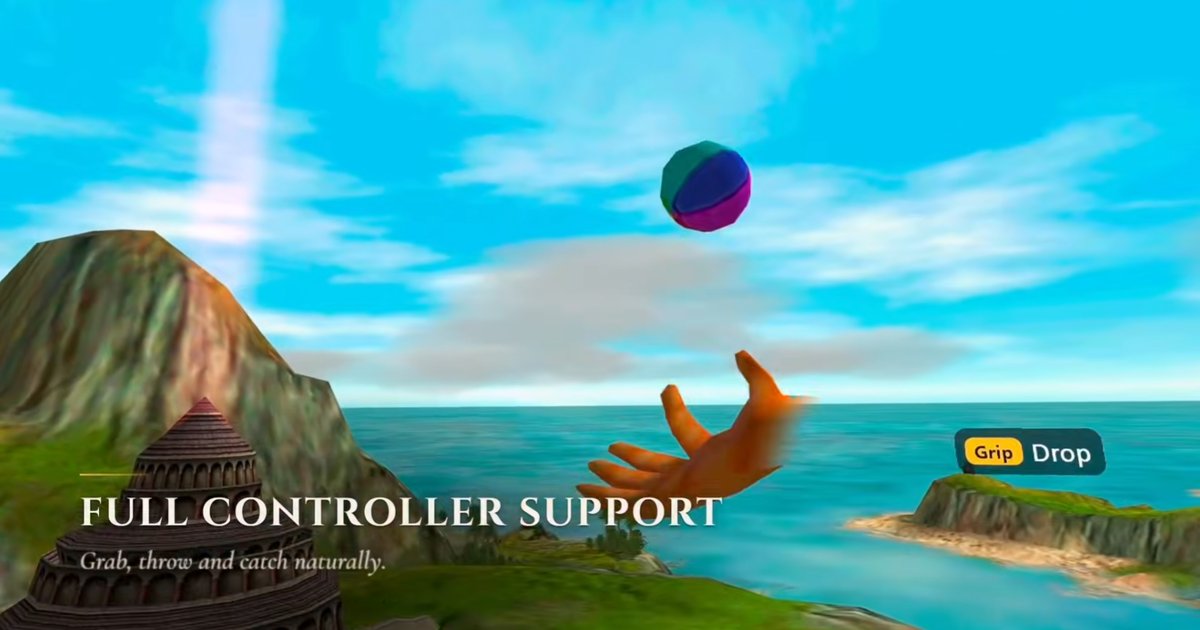
| 4. Camera / 6DoF VR conversion | Praydog/UEVR or King-EJ/AutoVR | Lua, C++, OpenXR, BepInEx, DX11/DX12 hooks | Low-Medium; disable EAC before injecting | Black & White VR, ACUnityFirstPerson |
1. Pick your track: browser rebuild, runtime bridge, or IPC passthrough
If your goal is a playable design experiment that anyone can click in five seconds without owning two PC games, build a clean-room browser hybrid. Write the mechanics from scratch in Three.js or Godot using original models and shaders. You avoid copyright takedowns, DLL injection headaches, and game patch breakage.
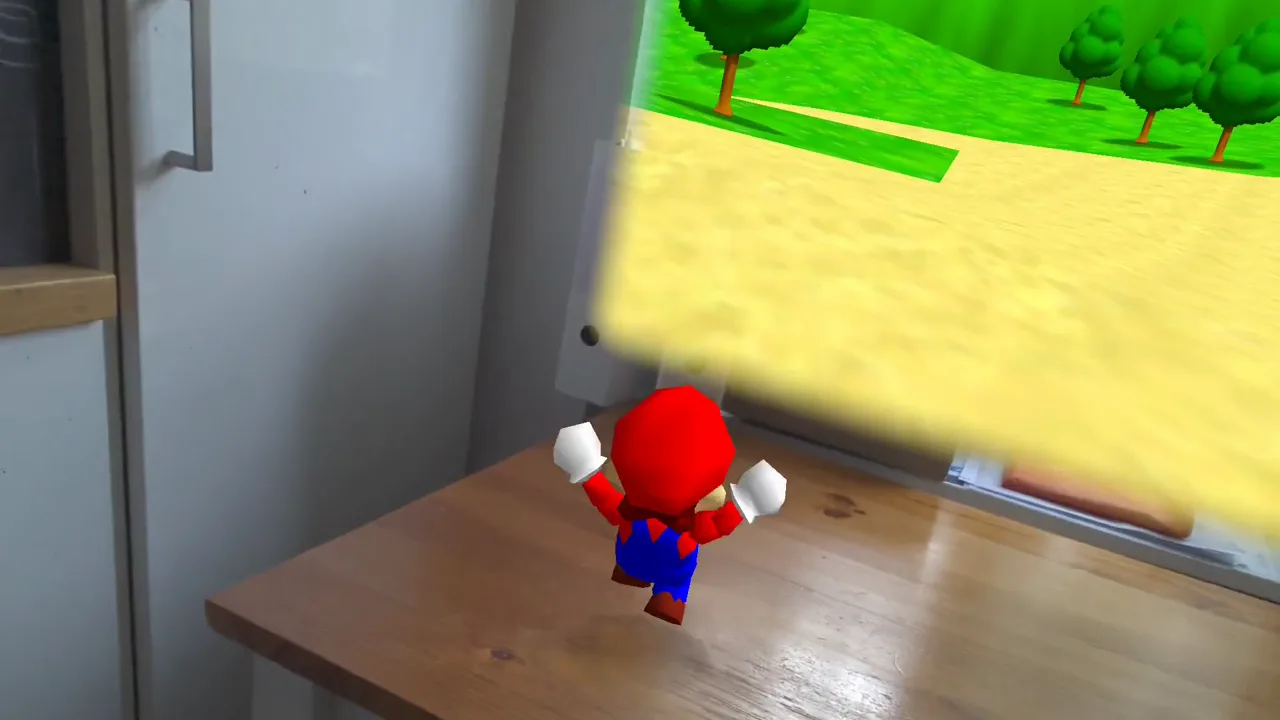
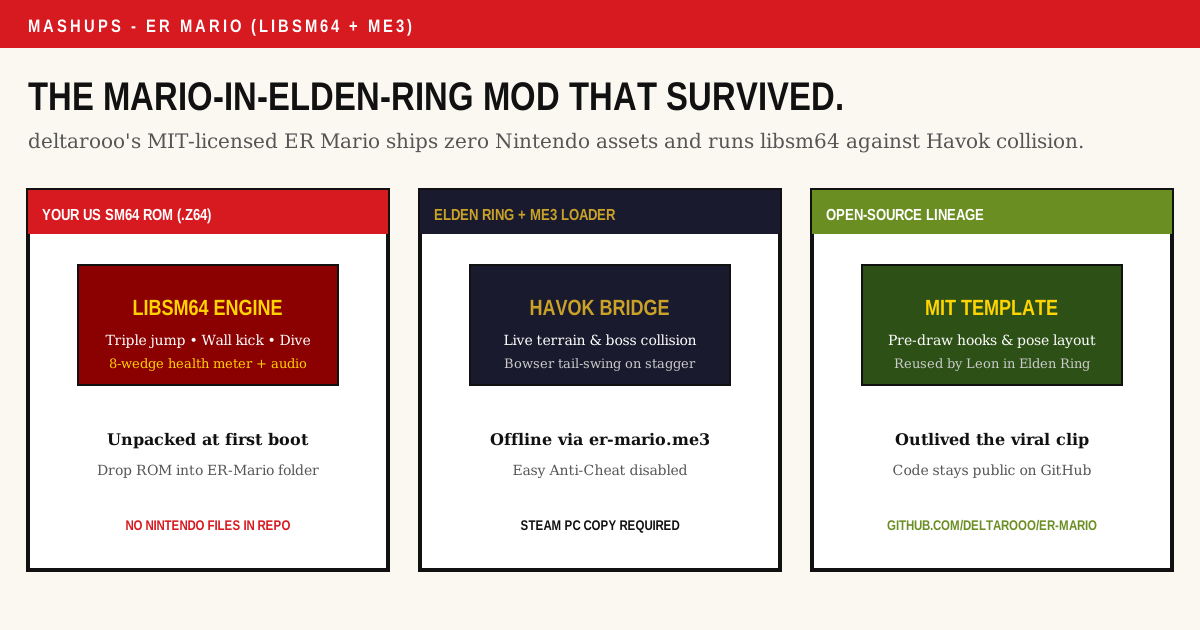
If you want a real character from Game A inside Game B's world, start from an open-source runtime BYO bridge. Rather than reverse-engineering two games from zero, fork deltarooo/er-mario (MIT). That repository demonstrates how to hook a DirectX 12 render loop with veeenu/hudhook, feed host collision triangles into libsm64, and unpack Mario's mesh and audio from a player-supplied ROM on first boot. SupMyNinja07 built Leon in the Lands Between by adapting ER Mario's pre-draw hook and pose-importer layout to read Resident Evil 4 (2005) files from a local Steam library.
If both games already have mature scripting hooks (such as Skyrim's SKSE64 and Minecraft's Fabric API), build a shared-memory passthrough. Instead of porting one engine into another, run both games at once and sync player coordinates, camera angles, and health across a named shared-memory pipe.
2. Open-source playbooks built for modding with AI agents
General-purpose coding models get lost when a reverse-engineering session stretches across multiple context windows. Modders in late 2026 rely on two game-specific open-source toolkits to keep agents focused and safe:
trevaintdead/ai-game-modding-guides: A collection of structured markdown blueprints written specifically for terminal agents (Claude Code, Codex, Gemini CLI). It includes a full worked example of a SkyCraft-style shared-memory passthrough (09-worked-example-passthrough-mod.md), Rust engine-rewrite guides, custom mod-loader patterns, and handover templates so an agent records verified memory offsets before its context window resets.rehan-remade/universal-modder: A command-line utility (um) and Model Context Protocol (MCP) server (universalmodder.dev) tailored for offline single-player modding. It gives agents engine-specific reconnaissance tools, backs up player save files automatically before every test run, and enforces hard guardrails that refuse to attach to online multiplayer or anti-cheat processes.- Published creator prompts and logs: Study real working artifacts before writing your own prompt. Pieter Levels published the exact Claude Code prompt and CrossOver recipe behind his custom GTA: San Andreas mission, and JackTulli left the entire 1,090-line agent engineering log (
HISTORY.md) inside the Halo 64 repository.
Both Buck (Black & White VR) and JackTulli emphasize the same rule: keep a human in charge of architecture and testing. Build in small, testable stages—render a box, lock the camera, wire inputs, then polish—rather than asking an agent to "put Game A into Game B" in one shot.
3. Warning: The risks of using REA (Reverse Engineer Anything)
As AI-assisted modding took off, REA (morluto/rea / rea-agents)—"Reverse Engineer Anything"—went viral on GitHub. REA is an open-source MCP server that connects coding agents directly to heavy binary-analysis tools including Ghidra, IDA Pro, Hopper, and JADX so an agent can decompile executables and trace functions autonomously.
While REA is a capable security-research bridge, treating it as a one-click game-mashup generator creates two major hazards for modders:
Risk 1: AI safety-classifier refusals and account suspensions
Frontier model providers (including Anthropic's Claude and OpenAI's reasoning tiers) run automated cyber-safety classifiers on every API turn. When you wire Ghidra or IDA directly into an agent through REA and ask it to inspect a commercial .exe or .dll, the context window rapidly fills with raw assembly, memory-patching routines, process-injection calls, and DRM or packer signatures.
To a safety classifier, automated binary disassembly of proprietary software looks indistinguishable from exploit development or malware analysis. Modders using REA against commercial games frequently hit hard model refusals mid-session. Worse, repeatedly prompting an agent to bypass binary checks or decompile protected executables can trigger automated abuse flags, resulting in temporary rate locks or permanent suspension of your AI developer account.
Risk 2: Legal, EULA, and anti-cheat landmines
Pointing automated reverse-engineering or memory-hooking tools at a modern PC game carries real legal and platform consequences:
- Anti-cheat bans are permanent: Never run REA, Ghidra debuggers,
hudhook, or unsigned DLL injectors against a game with active Easy Anti-Cheat (EAC), BattlEye, Vanguard, or Ricochet. As our coverage of Helldivers 2 and Ace Combat 8 showed, kernel and user-mode anti-cheat systems treat unauthorized memory inspection and DLL hooks as cheats. Always launch single-player targets offline using documented bypass loaders likeModEngine2orme3. - Silent crash-report telemetry: Even single-player games phone home. As the RDRVR README warns for Red Dead Redemption on PC, a crash with a mod DLL loaded still sends a crash dump to Rockstar's servers. Strip or disable telemetry in offline sandboxes before testing unstable hooks.
- EULA breaches and DMCA Section 1201: Most commercial End User License Agreements forbid disassembly and decompilation. In the United States, bypassing encryption or DRM wrappers (such as SteamStub or Denuvo) implicates the anti-circumvention provisions of the Digital Millennium Copyright Act (DMCA), even if you never distribute a file.
For direct links to every repository, mod loader, Discord server, subreddit, and developer mentioned here, visit our new Resources directory.