Watch five AI game mashup clips and they look like the same trick: a hero from Game A sprints through Game B while two HUDs share the screen. Open their public repositories and you find three distinct architectures with different hardware bills, failure modes, and copyright risks. This overview draws on public documentation rather than local builds.
Knowing which blueprint a mashup uses tells you what the install demands. You might need 16 GB of RAM for two AAA executables, a console ROM in a sidecar folder, or just a browser tab.
A mashup clip hides the plumbing. The README tells you whether two engines are negotiating in RAM or one binary is reading three asset formats.
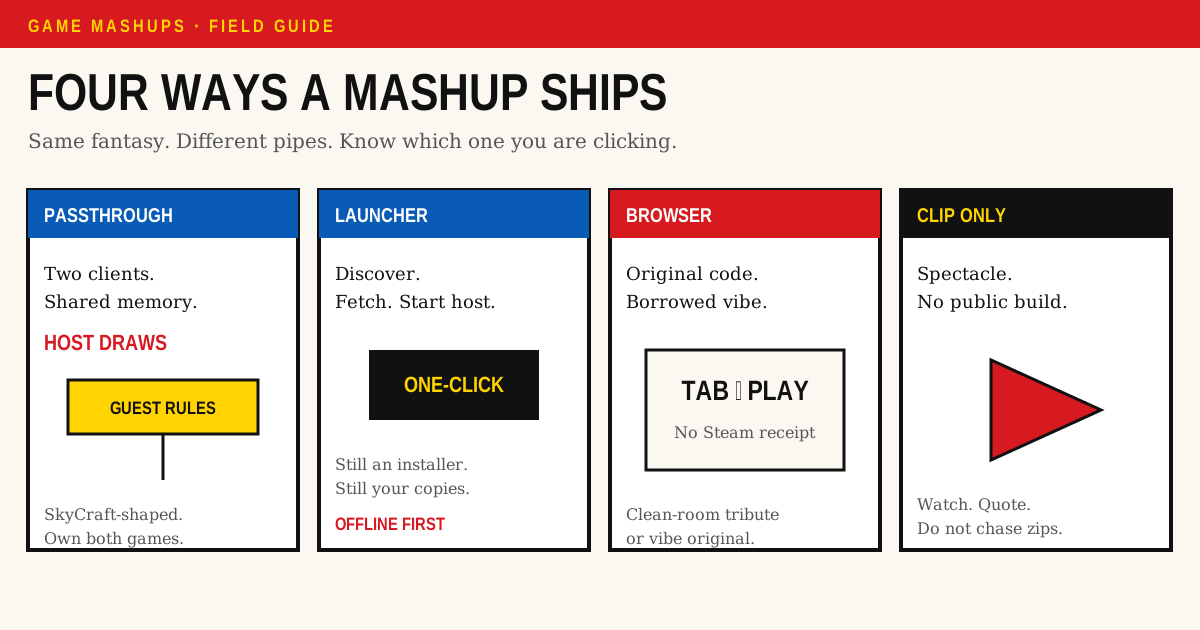
| Architecture | Flagship examples | Processes running | What you supply | Main failure mode |
|---|---|---|---|---|
| Shared-memory passthrough | SkyCraft, ArkWeb | 2 full games at once | Owned PC installs of both games | Desyncs, out-of-bounds clipping, high RAM/VRAM draw |
| Runtime physics & asset hook | ER Mario, Leon in the Lands Between | 1 host game + injected DLL | Host game on Steam + donor ROM or Steam install | Patch version mismatches, anti-cheat blocks |
| Rust engine rewrite | 2010 Rust Rewrite | 1 custom Rust binary (iw4l.exe) | Owned base game folders / extracted ISO | Incomplete campaign or netcode parity |
| Clean-room browser rebuild | GameMash, Slay the Spore | Browser tab | Nothing | Shallow tribute mechanics |
1. Shared-memory passthrough bridges: SkyCraft and ArkWeb
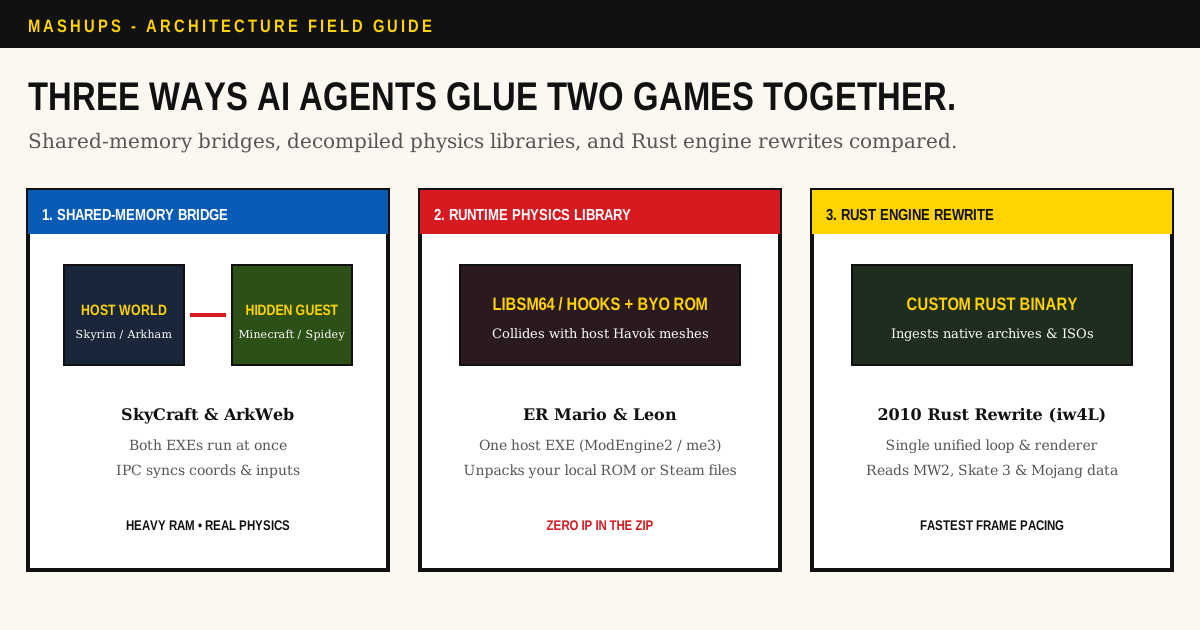
A passthrough mod refuses to port Game A into Game B. Instead, it launches both games simultaneously on one PC and hides the guest window. An inter-process communication (IPC) pipe in shared memory then trades coordinates, camera vectors, and inputs every frame.
SkyCraft (catalog card) is the cleanest released example. An SKSE64 plugin inside Skyrim Special Edition talks to a Fabric mod inside a bundled Prism Launcher instance of Minecraft: Java Edition. Minecraft owns player movement, inventory, block placement, and combat swing timing. Skyrim owns the world renderer, NPCs, quests, and weather. When you dig a hole in Whiterun, both engines update their collision state.
ArkWeb (Spider-Man in Gotham) applies the same dual-process trick to two heavier AAA action games: Marvel's Spider-Man Remastered (Steam build v4.0630) and Batman: Arkham Knight. Both games run concurrently. Spider-Man calculates web-swinging pendulum physics and wall-running in the background against synced collision data, while a custom DLL injects his pose and movement into Arkham Knight's Gotham renderer.
Two modern engines rarely agree on every building contour. ArkWeb's README documents a practical escape hatch: players edit a live command log (logs\sm_cmd.txt, such as hero tp 0 200 0) to teleport Spider-Man into clear air when he clips inside an Arkham skyscraper. Shared-memory bridges preserve the guest game's movement controller, at the cost of running two full games on one machine.
2. Runtime physics libraries and BYO loaders: ER Mario and Leon
When one game has already been decompiled into a portable C library, or when a modder only needs a character's state machine and weapons, running a second executable is overkill. Instead, a single DLL hooks the host game's loop and reads donor assets from the player's hard drive at launch.
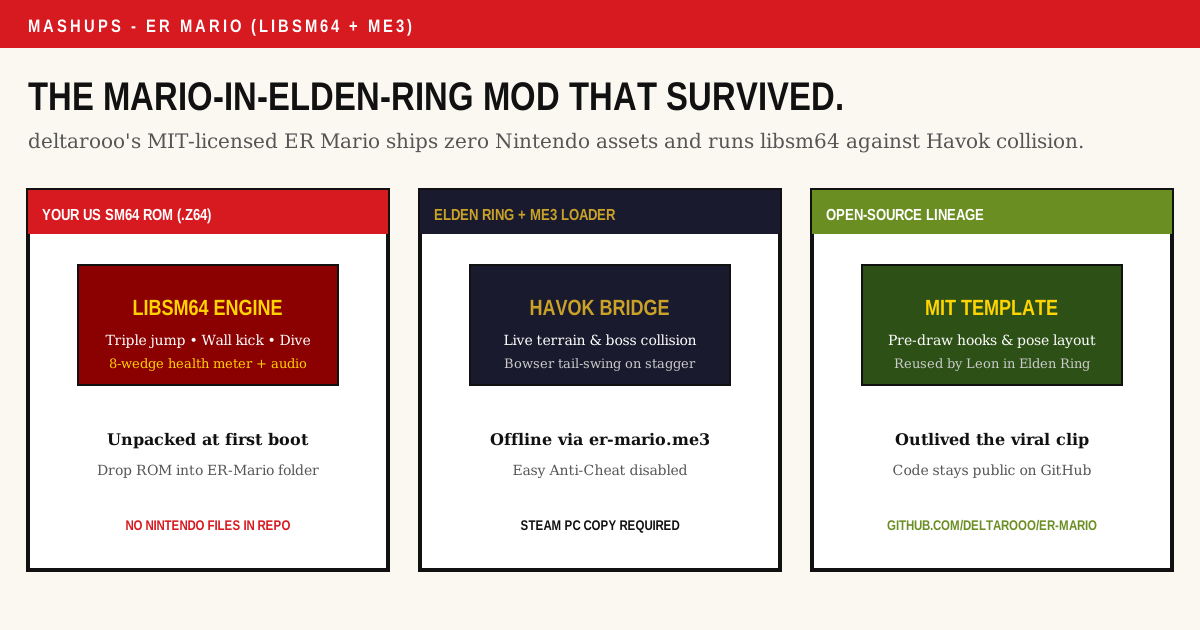
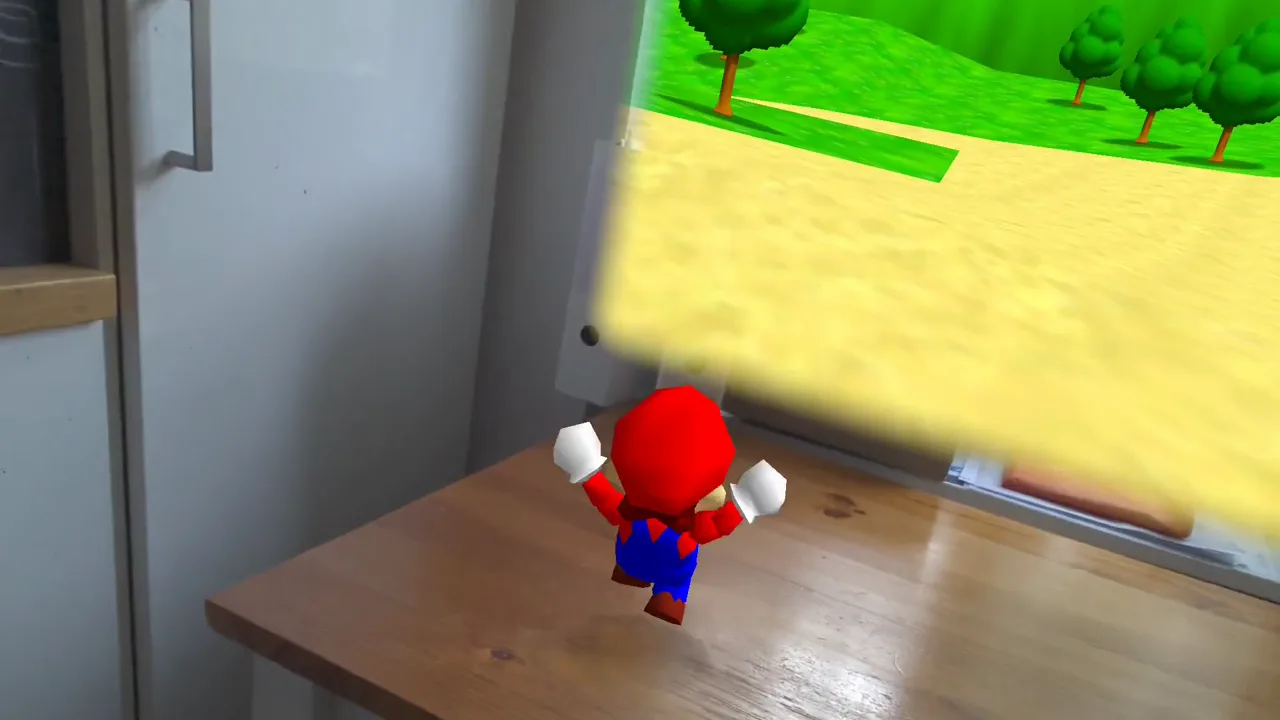
ER Mario (full write-up) pairs Elden Ring with libsm64, a portable physics library built from the Super Mario 64 decompilation project. Loaded offline through me3, the mod feeds Elden Ring's live Havok collision triangles into libsm64 so Mario can triple-jump, wall-kick, and ground-pound across Limgrave. The repository contains zero Nintendo files; you drop your own US .z64 ROM into the folder, and the mod extracts Mario's mesh, textures, and sounds on first boot.
Leon in the Lands Between (covered here) adapts ER Mario's MIT-licensed pre-draw hook and pose-importer layout for a Steam-to-Steam crossover. Rather than unpacking an N64 ROM, SupMyNinja07's mod checks your local Steam library for the 2005 Resident Evil 4 Ultimate HD Edition. At launch, it loads Leon's model, over-the-shoulder camera rig, weapons, and audio into Elden Ring via ModEngine2.
3. Custom Rust rewrites: 2010-rust-rewrite-mashup
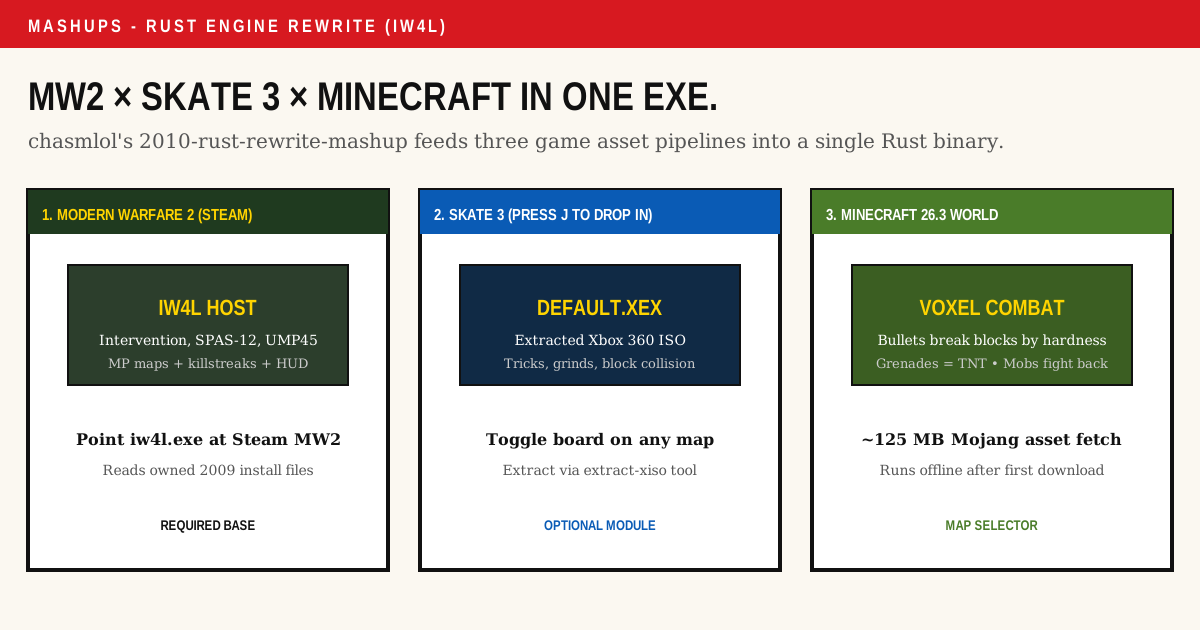
The third route ditches the original host executable altogether. In 2010-rust-rewrite-mashup (full write-up), chasmlol starts from an iw4L Rust rewrite of Modern Warfare 2 (2009). That single binary parses Skate 3's extracted Xbox 360 default.xex alongside official Minecraft assets fetched from Mojang.
Because one Rust codebase owns the render loop, physics tick, and entity list, cross-game interactions become first-class rules rather than memory patches. MW2 bullet damage scales against Minecraft block hardness, grenades act like TNT, and pressing J switches the player controller to a skateboard without alt-tabbing between processes.
4. The agent toolkits behind the wave
Why did all three architectures accelerate in late 2026? Modders stopped writing memory hooks and asset parsers from scratch and started pointing terminal coding agents (Claude Code, OpenAI Codex, and Gemini CLI) at game directories using shared playbooks.
Two open-source repositories now anchor that workflow:
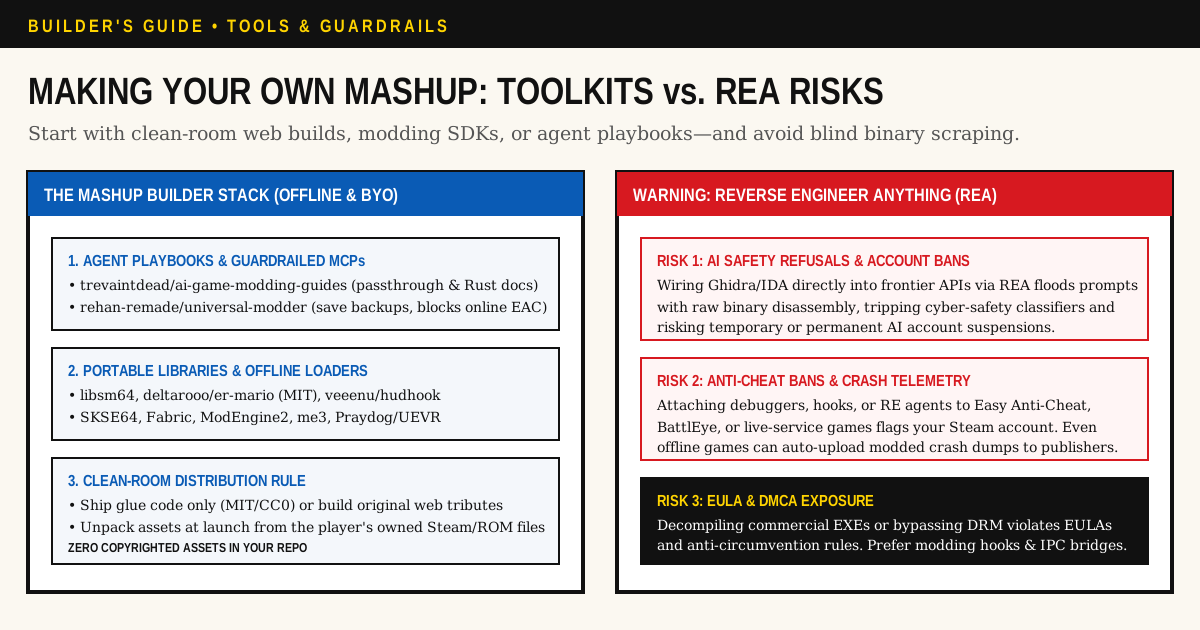
trevaintdead/ai-game-modding-guides: A blueprint library for autonomous coding agents. Its guides walk through passthrough bridges (including a worked SkyCraft-style example), Rust engine rewrites, custom mod loaders, and context-handover templates so an agent can reverse-engineer structs across multi-hour sessions without losing track of memory offsets.rehan-remade/universal-modder: A command-line tool (um) and Model Context Protocol (MCP) server (universalmodder.dev) that gives coding agents structured game-reconnaissance skills, engine playbooks, automatic save-file backups, and strict guardrails that refuse to touch online anti-cheat or multiplayer cheats.- Melty (
melty.gg): On the distribution side, Stella Montis Inc.'s Windows launcher packages finished BYO mods, from SkyCraft and Skate Warfare to Spartan Warfare (MW2 × Halo: The Master Chief Collection) and 7 Days to Resident Evil 4, behind a one-click Play button, alongside a "Mod with AI" prompt workflow for local libraries.
Next time a crossover clip crosses your timeline, check whether the creator published a shared-memory bridge, a runtime ROM loader, a Rust rewrite, or nothing at all. You can browse every verified project we track on the All Mashups page.