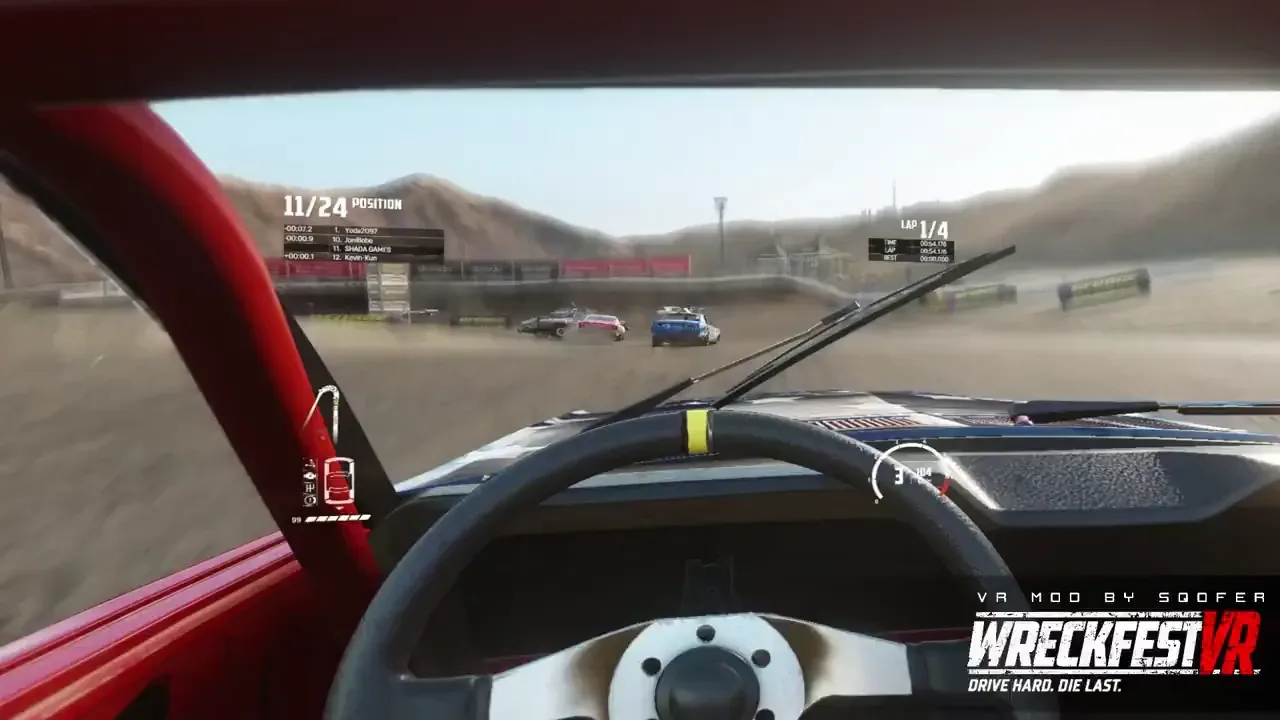
Most of the mashups we catalog smash trademarks together until sparks come out. This piece is about a quieter heresy: leave the IP alone, move the camera. If a game already stores real 3D meshes, collision, and a depth buffer, someone eventually asks whether you can stand inside that space—first-person on a monitor, or six degrees of freedom in a headset—without waiting for an official remake that will never come.
That question sits next to AI mashups on this site because both are creative mods: unofficial software that changes how a shipped game is experienced. The difference is ethical texture. A first-person Diablo mod is still using Blizzard's client, with all the usual offline-only caveats. It is not also borrowing Nintendo's mascot for a viral clip. The craft is graphics plumbing, input mapping, and nausea management—not franchise karaoke.
If the world was modeled in three dimensions, someone will try to put your head inside it.
Why "built in 3D" is the whole thesis
Sprite games can be faked into perspective with billboards and shaders; they cannot honestly answer "what does this alley look like from eye height?" when the alley was never a mesh. Remasters that rebuild geometry change the math. Diablo II: Resurrected (2021) is the teaching example: Blizzard's remaster draws polygonal characters and spaces over the bones of a 2000 isometric ARPG. Once those meshes exist, camera mods stop being pure hallucination and start being trigonometry.
The same logic explains why Unreal Engine catalogs dominate flat-to-VR conversations. A UE4/UE5 title already speaks a stereo-capable engine dialect. Injectors can ask for a second eye, a head-tracked camera, and UI quads in world space. Unity games, custom engines, and 2D frameworks each need their own stories; this feature sticks to what we can document from primary project pages—and to mods that convert flat games into VR or first-person views. Native VR titles designed for headsets from day one are out of scope here.
Case study: unlocking Diablo II: Resurrected's camera
D2R-3D — zoom until the isometric contract breaks
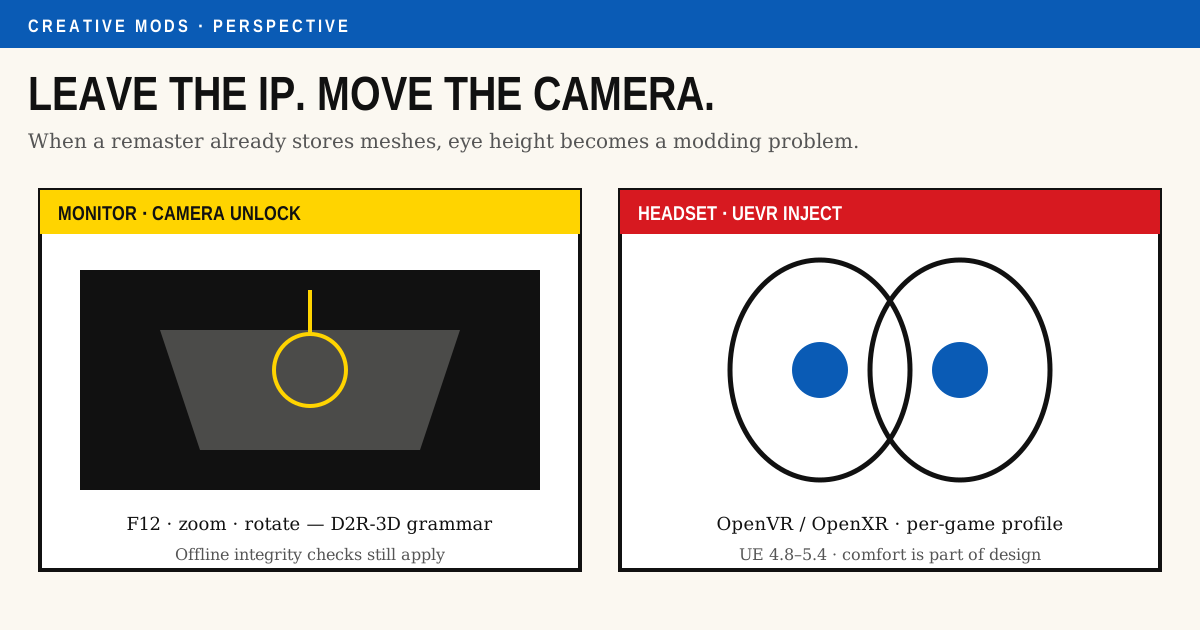
emmericp's D2R-3D is refreshingly small in ambition and large in effect. The README states the contract in one breath: add camera control to Diablo II: Resurrected; press F12 to activate; use the mouse wheel to zoom; hold the middle mouse button and drag to rotate. That is the entire pitch. From a higher angle you get something like a conventional action-RPG chase camera. Zoom all the way in and the remaster's meshes fill your monitor like a first-person crypt crawl the original game could not have rendered.
The project ships a standalone pair of binaries you drop beside D2R.exe, and a plugin build that can separate camera control from render-distance tweaks (F12 enables both; Shift+F12 camera only, per the README). Coverage in outlets such as DSOGaming repeats those controls and notes the obvious fantasy: third-person, WoW-ish high camera, or first-person, all without rewriting Sanctuary. The repo README also embeds screenshots (img/diablo.jpg, bloodraven.jpg, pindleskin.jpg); the project publishes no licence we can rely on for republication, so we link the repository rather than host those frames.
The warning is not subtle. The standalone README says the build will trigger Diablo II's integrity check and the game will crash after a minute. Treat that as a hard requirement for offline tinkering, not a challenge to defeat. If you need online services, this mod is not for that session. Creative camera work and always-online anti-tamper are natural enemies.
D2R VR — four views, one remaster
Where D2R-3D pries the camera loose on a monitor, the diablo2-vr-port project (often discussed as D2R VR) tries to put the remaster on your face. The public README describes a D2RLoader plugin, a ReShade fog effect, and a BodyWalk bridge for headsets via FlatVR. Views are bound to function keys:
- F1 — From above: the classic camera, redrawn with real perspective and stereo when "real geometry" is on.
- F2 — Third person: a free camera behind the hero, turned with your head.
- F3 — The game on your floor: a headset diorama view—Sanctuary as a tabletop world under your feet (without a headset, F3 is first person).
- F4 — First person (preview): stand at hero height with head tracking; the motion-control path is unfinished.
The authors are more honest than most hype reels. F4's first-person path is labeled a preview: motion controls and weapon aim are unfinished work, and a Weapon Adjust panel exists so you can fix offsets by hand. Headset fantasy is easy to film and hard to finish. Same republication caution as D2R-3D: if a README image lacks a clear licence, we point at the repo instead of mirroring Blizzard-looking frames on our CDN.
I have not personally cleared Act II in a headset for this article; I am describing the project's own documentation and the architectural claim it shares with D2R-3D: Resurrected's 3D assets are the enabler.
Case study: Half-Life 2 put into VR after the fact
If Diablo is the remaster-meshes sermon, Half-Life 2: VR Mod is the flagship "this flatscreen classic already had the world; someone finished the headset pass" story. The Source VR Mod Team ships the mod (and Episodes) as a Steam title under app 658920; the team's own trailer is the cleanest way to see the claim without a sales pitch from a third channel.
What matters for this site's thesis is the conversion direction: Valve's 2004 game was not a native VR product. The mod team rebuilt locomotion, interaction, and stereo presentation so a headset player can inhabit City 17. That is a different industrial process from buying a game that was blocked out for roomscale from the first vertical slice. When people casually cite polished VR shooters as the "bar" for injectors, they are often comparing a finished flat-to-VR conversion to a weekend UEVR profile. Keep the categories straight: HL2VR is a dedicated conversion project with a store page; UEVR is a wrench you aim at whatever Unreal EXE is in your library.
Case study: R.E.A.L. VR and the Luke Ross lane
Not every flat-to-VR path is an open GitHub injector. Luke Ross's R.E.A.L. VR is a Patreon-distributed modding lane that has become the default conversation for certain big third-person and first-person PC titles—Cyberpunk 2077 among them. The creator's own teaser is the primary video we can verify:
Ross's approach sits beside UEVR rather than inside it: different toolchains, different game lists, same player fantasy of "I already own the flatscreen build; put my head in it." Comfort, performance, and UI still dominate the bug reports. Treat Patreon builds like any other unpaid beta: read the current post for your exact game version, and do not chase repacked mirrors.
Case study: NomaiVR — Outer Wilds as a headset mystery
NomaiVR by Raicuparta (with artumino) is the clean Outer Wilds example: a community VR mod with a primary repo, an Outer Wilds Mods listing, and a creator-channel video that shows the conversion without a marketing department rewriting the pitch.
Outer Wilds was built as a flatscreen exploration loop. NomaiVR is the argument that its solar-system-scale curiosity still works when your neck is the camera rig—and that a focused single-game VR mod can outshine a generic injector when someone sweats the interactions. If UEVR is a toolbox, NomaiVR is a finished cabinet for one beloved title.
Case study: REFramework VR and praydog's RE Engine work
praydog's REFramework (docs at reframework.praydog.com) is the Resident Evil Engine toolkit that unlocks VR paths and first-person modes for titles such as RE2, RE3, RE7, and Village, with 6DOF options in other RE Engine games. We could not find a creator-channel trailer that cleanly demos the VR path the way HL2VR or NomaiVR do. Third-party coverage exists; label it as such. The embed below is not an official praydog upload—it is outside coverage of an RE Engine VR mod session:
Use the GitHub releases and praydog's own docs as the source of truth. YouTube packaging of horror VR mods is a cottage industry; the README is still the install manual.
Case study: UEVR and the Unreal attic
UEVR by praydog is the closest thing flat-to-VR modding has to a general-purpose wrench for Unreal Engine 4.8 through 5.4 games (ceilings move with releases; check the tag you download). The documentation site and GitHub README agree on the shape of the tool:
- A frontend injector (
UEVRInjector.exe): launch the game, pick the process, choose OpenVR or OpenXR, inject. - Full 6DOF head tracking and stereoscopic 3D when the pipeline cooperates.
- Multiple rendering modes (native stereo, synchronized sequential, alternating/AFR) because games break in different ways.
- Optional motion controls and roomscale movement in many titles, plus per-game configs and a plugin/Lua surface for people who deepen a profile.
We found no official creator-channel trailer that introduces UEVR the way Source VR Mod Team introduces HL2VR. That absence is editorial information: UEVR's primary sources are the GitHub repo and docs.uevr.io, not a launch film. Community captures and third-party roundups exist; if you embed one elsewhere, label the channel. Here we refuse to invent a fake "official" ID.
UEVR is not a magic "make any Steam game into a finished VR campaign" button. It is a bet that the engine already knew how to draw two eyes, and that a careful injector can convince a flatscreen build to do so. UI may float correctly or may need profiles. Performance may be fine or may demand DLSS begging. Some games are celebrated in community spreadsheets; others are marked as poor citizens. The honest player workflow is: confirm the game is Unreal (tools like Raicuparta's Rai Pal are mentioned in UEVR's own docs for library scanning), check whether a community profile exists, inject offline first, and be ready to disable motion blur and fancy temporal effects when ghosting appears.
A concrete profile: Hogwarts Legacy
Bare injection is only half the story. Community profiles are where a third-person Unreal game becomes a first-person headset session with sane controls. Hogwarts Legacy is a clear public example: guides such as DarkSigmaDevelopment's how-to walk through praydog's injector plus a first-person profile (credited to Discord users including Pande4360, jbusfield, and DJ; also mirrored on Nexus Mods and GitHub). Without the profile, UEVR can still put the game in stereo behind an Xbox pad or mouse. With it, the pitch becomes first-person view, a motion-controlled wand, and VR-oriented turning options—exactly the difference between "the engine drew two eyes" and "someone finished the control scheme." Treat profile version pins seriously; those guides often name a specific UEVR nightly when a newer build breaks the import.
What UEVR is not
It is not a license to pirate. It is not a promise that third-person action games will feel good with a neck-driven camera. It is not Melty; it will not download a mashup of two IPs. And it is not a substitute for a design pass that rebuilds levels and interactions around a headset. Injectors borrow a flatscreen grammar and hope your stomach agrees; dedicated flat-to-VR conversions (HL2VR, NomaiVR, a cared-for REFramework profile) sweat that grammar into something closer to a product.
How these mods differ from AI mashups
| Impulse | AI mashup wave | Creative camera / VR |
|---|---|---|
| Fantasy | Play game A with game B's rules or mascot | Stand inside game A's existing world |
| Typical ask | Two owned titles, or a browser tribute | One owned title + tools/headset |
| Failure mode | Copyright claim, unreleased clip, broken bridge between processes | Integrity crash, UI unreadable, simulator sickness |
| Catalog home on this site | /mashups/ tags and Melty/Browser badges | Discussed here; we link primary repos rather than inventing fake mashup rows |
Both belong on a site that cares about unofficial creativity. Only one belongs in a "two games walk into a bar" punchline.
What is worth playing (for different appetites)
Atmosphere hunters with a gaming PC and no headset. D2R-3D's zoom/rotate loop is the cheapest revelation: Blood Moor at eye height, a Forgotten Tower corridor that suddenly has a ceiling. Accept the offline crash timer as the price of admission, or skip the standalone build if that price is too high.
VR tinkerers who like unfinished instruments. D2R VR's F1–F3 views are the sensible path; treat F4 as a museum label that says "preview." UEVR is the wider playground if your library is stuffed with Unreal titles—and a profiled title like Hogwarts Legacy shows what "wider" means when someone has already done the first-person and motion-control work. REFramework is the parallel lane when your backlog is Capcom's RE Engine catalog.
Players who want a finished conversion. Prefer dedicated flat-to-VR projects with primary docs and a real install story—Half-Life 2: VR Mod on Steam, NomaiVR via the Outer Wilds Mods ecosystem, Luke Ross builds when your target game is on his list. Creative injectors are journalism and craft, not a refund policy.
Mashup tourists. If you came here from SkyCraft or GameMash, keep the categories straight. Shared-memory Minecraft-in-Skyrim is a mashup. Head-tracked Elden Ring via an injector (when a profile works) is a perspective mod. Both can be profound. They answer different wishes.
Risk, comfort, and a ten-minute audit
Camera and VR injectors often touch memory, load DLLs, or ride loader frameworks. That is catnip for anti-cheat and integrity systems. Stick to single-player or explicitly offline modes. Download from the creator's GitHub releases or the URLs their README names—not from SEO scrapers. Expect breakage after game patches; remasters patch more quietly than you think.
Flatscreen games assume a fixed camera grammar: cinematic FOV, head bob as flavor, motion blur as sauce. Headsets punish those assumptions. Alternating-frame stereo can look fine in a trailer and awful in your vestibular system. Third-person games force a negotiation between where your neck points and where the character's hips face. Isometric ARPGs that suddenly zoom to eye level may reveal animation loops that were never meant to be stared at from six inches away. A finished flat-to-VR conversion budgets time for comfort options; a bare injector inherits a combat loop that assumed a sofa. If you are prone to simulator sickness, prefer monitor-based camera unlocks (D2R-3D's zoom) before headset experiments, and treat every new Unreal inject like a spicy food: small portion, lights low, exit ready.
Before you rearrange your afternoon around a GitHub release, run a short audit:
- Primary source first. If the README and a YouTube thumbnail disagree, the README wins. D2R-3D's crash-after-a-minute warning is the kind of sentence thumbnails omit.
- Name the dependency stack. Loader plugins, ReShade, BodyWalk, SKSE, Injector EXE—each is a moving part that can break when the game patches. Count them.
- Separate view from control. A first-person camera is not the same as first-person melee with tracked hands. UEVR's optional motion controls, a Hogwarts wand profile, and D2R VR's F4 preview live on different difficulty planets.
- Decide your success condition. Atmosphere screenshot? Full campaign? Thirty nausea-free minutes? If you cannot name the win, you will call a tech demo a failure when it was only ever a demo.
- Plan the exit. Know how to remove DLLs, disable plugins, and verify file integrity through the store client when you are done. Creative mods should be reversible chores, not hauntings.
We will not pretend every Unreal game is "VR ready," and we will not invent compatibility percentages. When community databases quote scores, treat them as anecdotes with a date stamp. A UEVR profile for a single Unreal game is closer to a graphics note than to Elden Craft. When a perspective project becomes as culturally central as SkyCraft, it earns a harder catalog entry. Until then, features like this one carry the journalism.
Why this belongs beside the mashup index
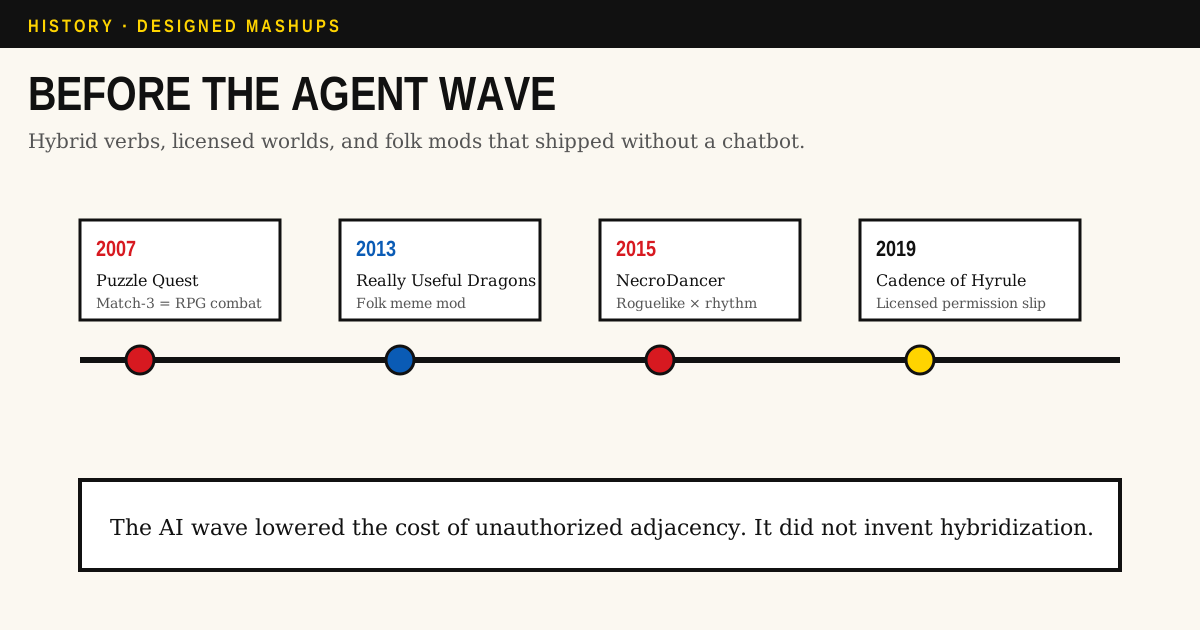
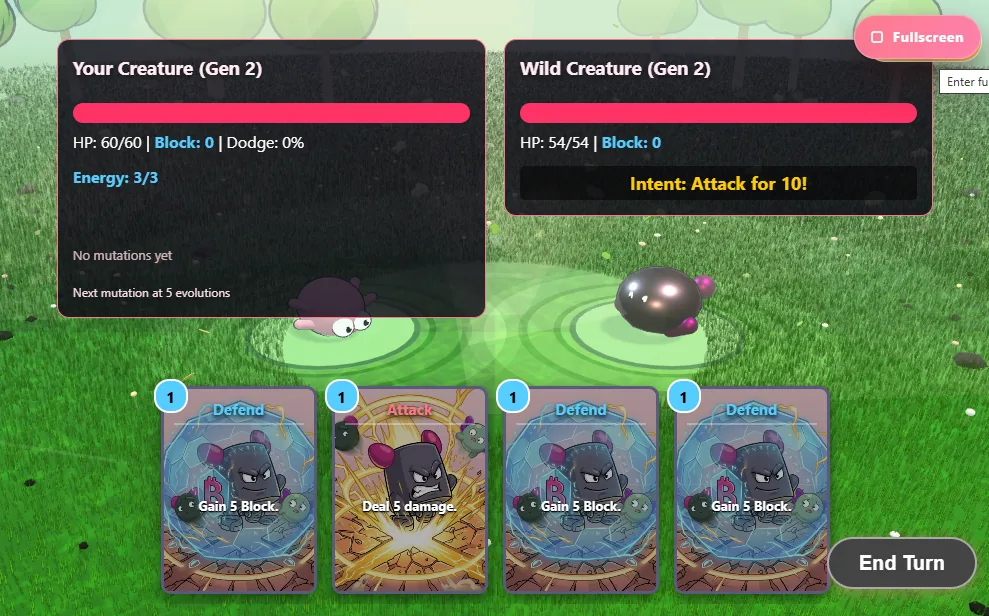
Game Mashups started as a phone book for collisions—Mario in the Lands Between, Spire cards with Spore DNA, Thomas the Tank Engine eating Skyrim's dragons (Really Useful Dragons). Expanding the site to creative camera and VR mods is not scope creep; it is admitting that combination can mean combining a world with a viewpoint the developer never shipped.
The through-line to our AI mashups pillar is player agency over shipped intent. Sometimes that agency braids two libraries. Sometimes it only asks for a different eye height in a library you already paid for. Both impulses produce screenshots that make strangers stop mid-scroll. Only one impulse needs a second store receipt.
Old PC magazines loved two genres of cover story: the hotness that might get you sued, and the technical feature that made you reopen a game you already owned. AI mashups are today's hotness. First-person Sanctuary, injected Unreal headsets, HL2VR, NomaiVR, and REFramework profiles are today's technical feature. We cover both—and keep your online characters far away from either experiment.