On October 17, 2026, developer Jacques Dupont (u/alloxrinfo on Reddit) announced the v0.1.0 public release of Port0r: House of the Dead VR on r/oculus:
"The House of the Dead is out in VR. Thank you again for Time Crisis: we're now 294 on the Discord, and your bug reports and feedback made this one possible... the zombies walk right up to you, your gloved hand holds a 3D gun."
This isn't an emulator running in a virtual cinema screen with a floating cursor. And it isn't the polarizing 2022 Unity remake. This is Sega's original 1996 Model 2 arcade game, running natively standalone on the Meta Quest 3, with its underlying 3D world redrawn in true stereoscopic depth at 120 Hz.
For anyone who spent rolls of quarters in the late 1990s ducking behind plastic cabinets at bowling alleys and seaside piers, the pitch is immediate nostalgia. But from a technical perspective, it represents the continuation of a fascinating preservation trend: turning classic arcade boards into standalone, six-degrees-of-freedom VR environments.
Not a virtual screen: lifting Sega Model 2 into stereoscopic 3D
When people hear "arcade game in VR," they usually think of emulators like New Retro Arcade: Neon or EmuVR—systems that simulate a physical wooden cabinet in a virtual room, with a flat CRT monitor displaying a 2D image.
Port0r does something radically different. In 1996, Sega AM1 and director Takashi Oda didn't build The House of the Dead out of 2D pre-rendered video. They built it on Sega Model 2, one of the most powerful 3D arcade boards of its era, powered by a 32-bit RISC CPU (NEC V60) and custom Fujitsu 3D geometry and texture-mapping processors. Every hallway of Dr. Curien's mansion, every swinging chandelier, and every grotesque zombie was defined as actual polygonal geometry and 3D vertex coordinates in memory.
What Dupont's Port0r engine does is intercept that real-time 3D pipeline:
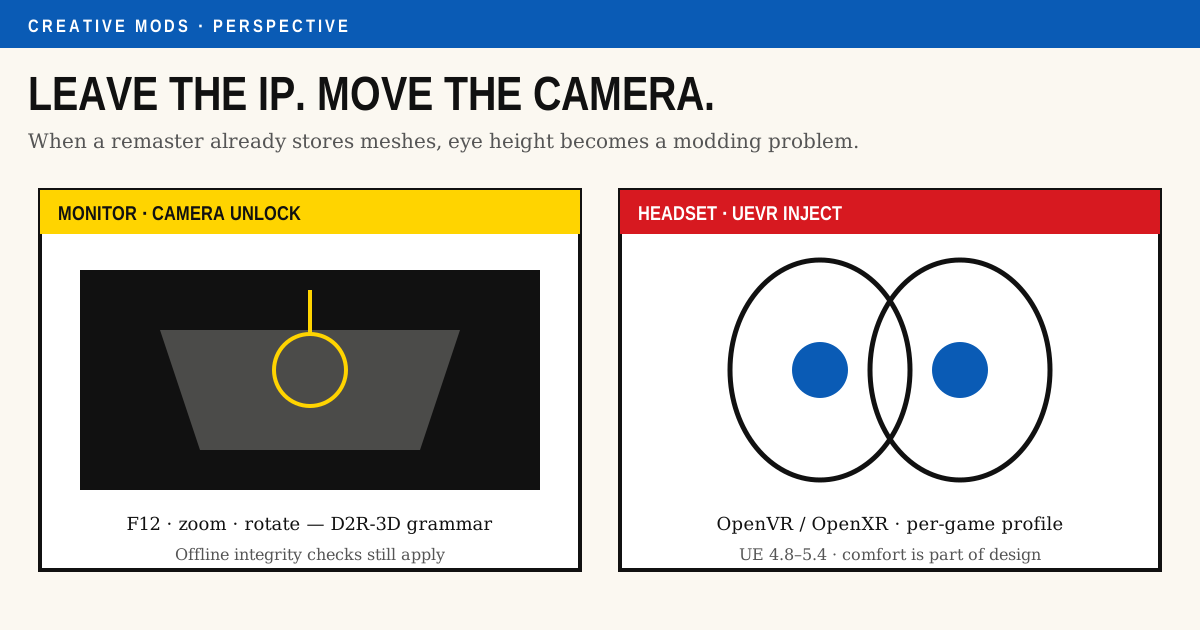
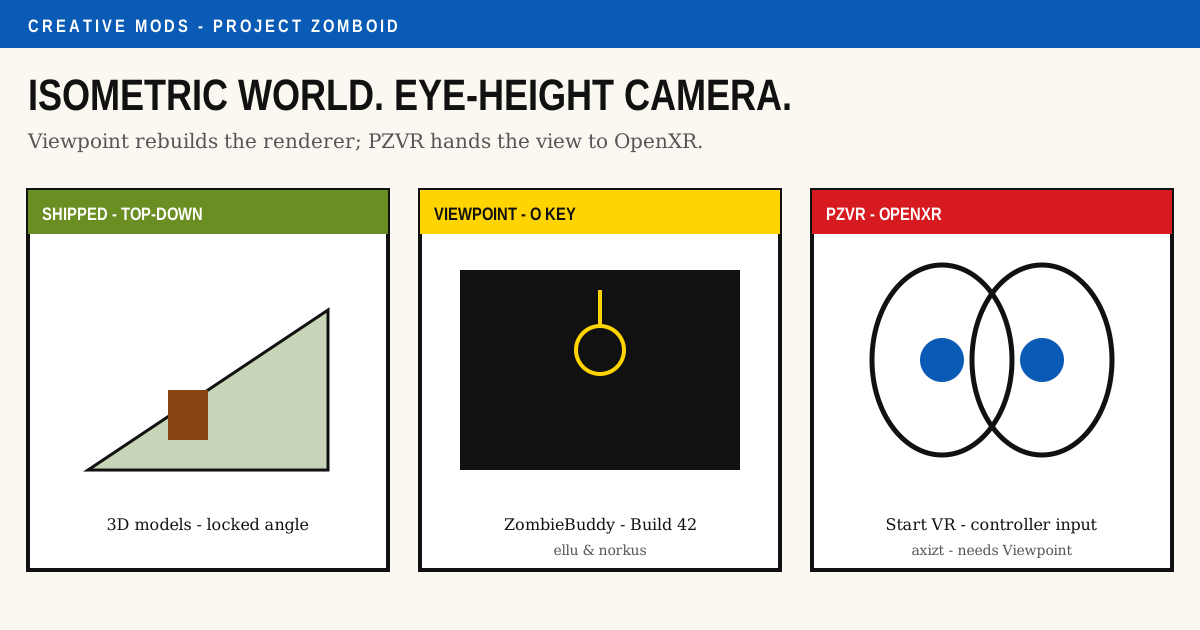
- Dual eye matrices: Instead of projecting the scene through a single monoscopic camera onto a flat 4:3 raster, Port0r computes two stereoscopic view matrices offset by the headset's physical inter-pupillary distance (IPD).
- True scale reproduction: Objects and creatures are rendered at real-world scale. The shambling axe-wielding mutants and leaping leeches aren't pictures on a screen; they occupy physical volume inches from your face.
- High-refresh native rendering: The game runs at the Quest 3's native high resolution and up to 120 Hz, eliminating the flickering phosphor fatigue of vintage arcade tubes while maintaining full original simulation speed.
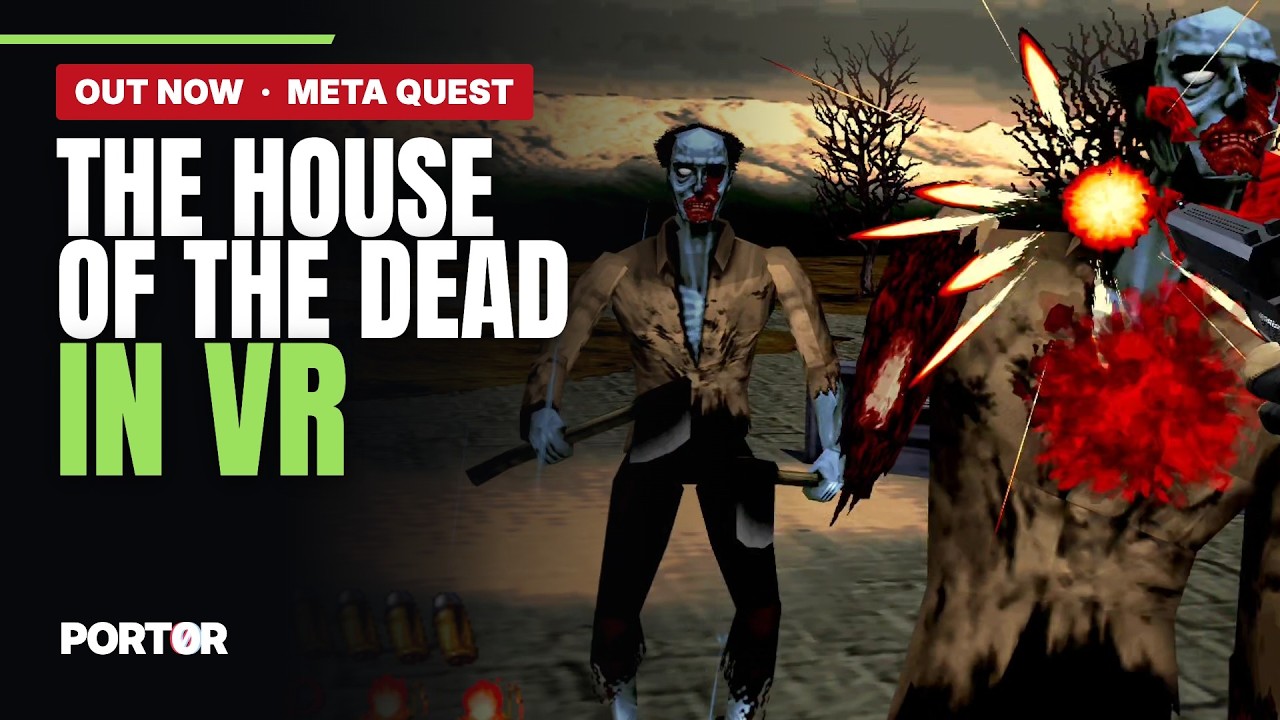
3D raycasting and lightgun muscle memory
The most profound shift between original lightgun hardware and VR is how hit detection works.
In a 1996 arcade cabinet, the lightgun contained a photodiode that sensed the CRT's raster beam scan line to calculate where on the 2D glass screen you were aiming. The game then mapped that 2D point back into its collision math.
In Port0r: House of the Dead VR, your Quest Touch controller becomes the physical weapon in 3D space:
- True 3D trajectory: The bullet trajectory is a 3D ray cast from the virtual barrel directly into the world geometry. Hits register on the exact limb, torso, or projectile you target in 3D depth—whether it's an axe flying through the air or a zombie lunging from a shadowed corner.
- Arm and gun models: Under Settings > Game > Arm, players can choose to see AMS Agent Thomas Rogan's gloved hand and modeled pistol, or toggle Settings > Game > Cabinet gun to hold a faithful 3D replica of the classic arcade cabinet's blue lightgun.
- Arcade reload: Rather than an artificial reload button, reloading honors the arcade ritual: aim off-screen / point down and pull the trigger to chamber six fresh rounds.
- Dynamic HUD: Classic text prompts, health torches, and "RELOAD!" warnings remain locked in your peripheral comfort zone, but gracefully float forward in Z-space if an enemy crosses your sightline so UI elements are never swallowed by zombie models.
- Uncensored presentation: Running the arcade export settings, the port features authentic red blood and English voice acting ("Don't come!").
The bring-your-own-ROM architecture
Like many modern reverse-engineering and preservation projects we cover on Game Mashups—from SkyCraft to Leon in the Lands Between—Port0r adheres to a strict "clean room distribution" policy:
The APK contains zero copyrighted Sega assets, ROM binaries, or proprietary audio.
The engine core is compiled from MAME's BSD-3-Clause source components, wrapped in an optimized Android/Vulkan native VR runtime. When you boot the application for the first time, a localized setup screen checks the headset's internal storage. If hotd.zip is present, the app extracts and verifies the ROM hashes against the standard MAME 0.289 database, builds its local shader cache, and boots seamlessly. If the files are missing or mismatched, the UI highlights exactly which CRC32 hashes are absent.
This clean separation is why Port0r can host its releases publicly on GitHub and SideQuest without infringing on Sega's intellectual property. You supply the game data; Port0r supplies the VR engine.
| Attribute | Vanilla Arcade (1996) | Port0r: House of the Dead VR (v0.1.0) |
|---|---|---|
| Platform | Sega Model 2 Arcade Board | Meta Quest 3 (Standalone Android/Vulkan) |
| Display | 24 kHz Medium-Res CRT (496x384) | 4K Stereoscopic VR per eye |
| Refresh Rate | 60 Hz | 120 Hz |
| Viewpoint | Fixed monoscopic camera on glass | Full 6DoF stereoscopic head tracking |
| Aiming | CRT photodiode sensor | 1:1 6DoF motion-tracked Quest controller |
| Reload | Point off-screen + trigger | Point off-screen + trigger (cabinet style) |
| Audio | Stereo QSound / Yamaha PCM | Spatialized stereo headset audio |
| Distribution | Dedicated coin-op cabinet | Free BYO-ROM APK + MAME hotd.zip |
On-rails camera movement and VR comfort
Rail shooters present a unique design challenge for virtual reality: forced camera locomotion.
In games like Half-Life: Alyx, the player controls their own movement through teleportation or continuous smooth locomotion. In The House of the Dead, the camera is an aggressive, cinematic rail director—rapidly turning corners, rushing through broken doors, and suddenly halting as mutants burst through the windows.
If implemented carelessly, artificial camera rotation is a notorious trigger for simulator sickness. Port0r tackles this with several crucial comfort choices:
- Independent head rotation: While the position along the track follows the arcade's scripted camera, your head orientation is never locked. You are free to turn your neck, look behind you, inspect the estate gardens, or glance upward at bats swooping from the ceiling.
- Rock-solid 120 fps: Vestibular comfort relies heavily on low motion-to-photon latency. Running at 120 frames per second on Quest 3's Snapdragon XR2 Gen 2 chip ensures head tracking remains completely responsive even while the virtual carriage pivots.
- Custom player height and comfort settings: The left controller's menu button summons a comprehensive in-game settings panel available in 10 languages. Players can adjust their virtual standing height, tweak HUD distance, toggle the aiming crosshair, and adjust resolution scaling to match their tolerance.
The growing Port0r arcade universe
The House of the Dead VR is not an isolated experiment. It is the fifth major arcade adaptation in Jacques Dupont's growing standalone VR lineup:
- Time Crisis VR (Namco System 22, v0.2.2): Introduces physical ducking and standing to operate Richard Miller's iconic cover pedal.
- Time Crisis II VR (Namco System 23, v0.1.0): Expands the formula to dual-screen shootouts with heavy weapon combat.
- Cop VR / Virtua Cop (Sega Model 2, v0.2.1): Recreates the original 1994 polygon police shooter that established the lightgun genre.
- Rally VR / Sega Rally Championship (Sega Model 2A, v0.2.6): Puts the player directly into the cockpit of the Lancia Delta and Toyota Celica, with full steering support and community HD texture packs.
With nearly 300 active players in its Discord and active feature development, Port0r is demonstrating that 1990s arcade games don't belong in a dusty nostalgia cabinet. Their low-polygon aesthetic, sharp silhouettes, and punchy, reflex-driven gameplay loops translate shockingly well into modern room-scale VR.
If you have a Quest 3 and your own arcade dumps, standing face-to-face with Curien's zombies at eye level might just be the most visceral way to replay 1996 you'll ever find.